
PLONVIT® SULVIT
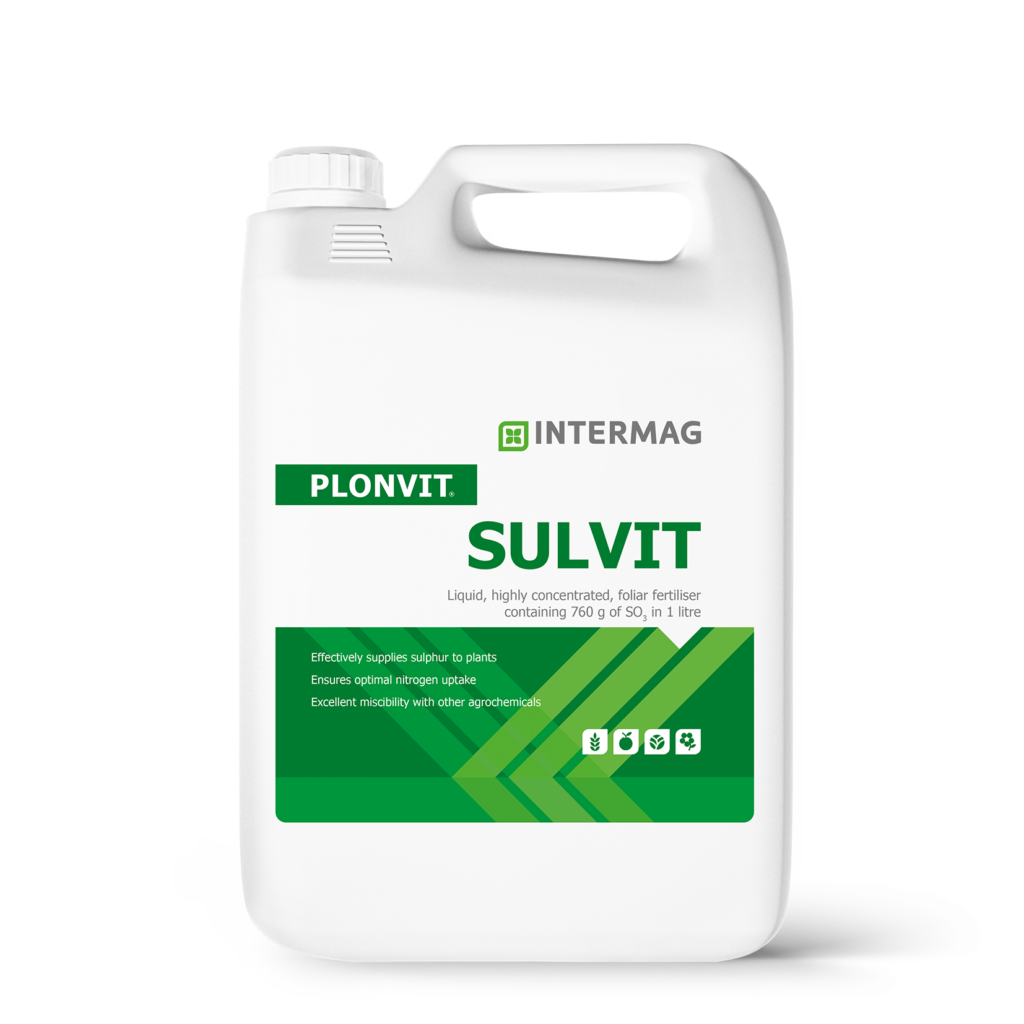
PLONVIT® SULVIT
El fertilizante foliar líquido, altamente concentrado, llega en forma de azufre en forma fácilmente disponible para las plantas
Descripción del producto
PLONVIT® SULVIT es un fertilizante de azufre líquido altamente concentrado (760 g de SO3 en 1 litro) destinado a la alimentación foliar de plantas o para su uso en suelos junto con fertilizantes nitrogenados líquidos (por ejemplo, UAN). Está especialmente recomendado para cultivos con altos requerimientos de azufre, así como durante períodos de mayor demanda de nitrógeno por parte de las plantas.
PLONVIT® SULVIT aplicado tópicamente como aditivo a fertilizantes nitrogenados líquidos (por ejemplo, UAN), previene la pérdida de nitrógeno (inhibidor del metabolismo del nitrógeno).
| Nutrientes | g/L | % (m/m) |
| Nitrógeno (N) total | 200 | 15.0 |
| Nitrógeno (N) amonio (NH4) | 140 | 10.5 |
| Nitrógeno (N) urea (NH2) | 60 | 4.5 |
| Trióxido de azufre (SO)3) | 760 | 57.5 |
| Azufre (S) soluble en agua | 304 | 23.0 |
PLONVIT® SULVIT utilizado profilácticamente es una fuente eficaz de azufre durante los períodos de mayor demanda de nitrógeno de las plantas (el azufre es necesario para que las plantas utilicen el nitrógeno del suelo y los fertilizantes) y en cultivos con altos requerimientos de azufre (p. ej., colza, repollo, coliflor, mostaza, rábano, cebolla, ajo, legumbres), así como en cultivos con altos requerimientos de nitrógeno (p. ej., cereales). El fertilizante se recomienda cuando existen condiciones del suelo que limitan la disponibilidad de azufre para las plantas (baja temperatura y humedad del suelo, suelos ligeros, alto contenido de calcio en el suelo). PLONVIT® SULVIT aplicado en los tiempos y dosis recomendados en los programas de fertilización para especies individuales, complementa y/o corrige eficazmente la fertilización del suelo y proporciona azufre fácilmente absorbible por las plantas en las etapas en que muestran mayor necesidad de este elemento.
La alimentación de intervención es aconsejable cuando hay síntomas visuales de deficiencia de azufre en las plantas o cuando los resultados del análisis del material vegetal indican que el contenido de azufre es demasiado bajo (deficiencia latente).
Azufre (S) proporcionado en PLONVIT® SULVIT tiene un efecto beneficioso sobre el tamaño y la calidad del rendimiento al:
- aumentar la eficiencia de la fertilización nitrogenada, mejor absorción de nitrógeno del suelo
- mejorar la energía de la fijación de nitrógeno libre por parte de las bacterias del suelo (por ejemplo, Rhizobium, Azotobacter, Azospirillum)
- intensificación del proceso de fotosíntesis: aumenta la biomasa de las plantas
- Curso adecuado de síntesis de proteínas y grasas
- aumentar el contenido de proteínas: aminoácidos esenciales en el cultivo (por ejemplo, mejorar el valor de horneado de la harina)
- mejorar el cuajado de granos y semillas
- aumentar la resistencia de las plantas a enfermedades y plagas
- mayor resistencia al estrés por sequía
- Mayor resistencia a las heladas.
Instrucciones de uso
- RADIADORES FOLIARES
PLONVIT® SULVIT está diseñado para aplicación foliar en forma de solución acuosa. PLONVIT® SULVIT se puede utilizar junto con otros agroquímicos después de realizar una prueba de miscibilidad. Las recomendaciones detalladas para la aplicación foliar se presentan en la siguiente tabla.
- USO EN COMBINACIÓN con UAN SOLUTION (u otros fertilizantes nitrogenados líquidos)
PLONVIT® SULVIT puede utilizarse en combinación con una solución de nitrato de urea-amonio para aumentar la eficacia de la utilización del nitrógeno (azufre presente en la PLONVIT® SULVIT es un inhibidor de la ureasa y la nitrogenasa). Dosis: 2-4 L de PLONVIT® SULVIT en 100 L de UAN.
Anuncio 1. Recomendaciones de aplicación foliar para cultivos seleccionados.
Las recomendaciones pueden modificarse teniendo en cuenta los requisitos y las condiciones de crecimiento de las plantas.
| Application times (◆ optimal, ◇ optional): | Direction for use: |
| ◇/◆ Autumn: 3–6 leaves unfolded The application time should be considered as optimal in case of low sulphur content in the soil. |
▪ Foliar treatments: 5 L/ha ▪ Combined use with UAN: 2–4 L/100 litres of UAN |
| ◇/◆ Spring: tillering The application time should be considered as optimal in case of high nitrogen fertilization, especially with liquid fertilizers (UAN), as well as in case of low soil sulphur content in soil. |
▪ Foliar treatments: 5 L/ha ▪ Combined use with UAN: 2–4 L/100 litres of UAN |
| ◇/◆ stem elongation The application time should be considered as optimal in case of high nitrogen fertilization, especially with liquid fertilizers (UAN), as well as in case of low soil sulphur content in soil. |
▪ Foliar treatments: 5 L/ha ▪ Combined use with UAN: 2–4 L/100 litres of UAN |
| ◇ flag leaf stage / beginning of heading | ▪ Foliar treatments: 5 L/ha ▪ Combined use with UAN: 2–4 L/100 litres of UAN |
| Application times (◆ optimal, ◇ optional): | Direction for use: |
| ◇/◆ leaf development – tillering The application time should be considered as optimal in case of high nitrogen fertilization, especially with liquid fertilizers (UAN), as well as in case of low soil sulphur content in soil. |
▪ Foliar treatments: 5 L/ha ▪ Combined use with UAN: 2–4 L/100 litres of UAN |
| ◇/◆ stem elongation The application time should be considered as optimal in case of high nitrogen fertilization, especially with liquid fertilizers (UAN), as well as in case of low soil sulphur content in soil. |
▪ Foliar treatments: 5 L/ha ▪ Combined use with UAN: 2–4 L/100 litres of UAN |
| ◇ flag leaf stage / beginning of heading | ▪ Foliar treatments: 5 L/ha ▪ Combined use with UAN: 2–4 L/100 litres of UAN |
| Application times (◆ optimal, ◇ optional): | Direction for use: |
| ◇ Autumn: 3–6 leaves unfolded | ▪ Foliar treatments: 5 L/ha ▪ Combined use with UAN: 2–4 L/100 litres of UAN |
| ◇/◆ Spring: continuation of tillering The application time should be considered as optimal in case of high nitrogen fertilization, especially with liquid fertilizers (UAN), as well as in case of low soil sulphur content in soil. |
▪ Foliar treatments: 5 L/ha ▪ Combined use with UAN: 2–4 L/100 litres of UAN |
| ◇/◆ stem elongation The application time should be considered as optimal in case of high nitrogen fertilization, especially with liquid fertilizers (UAN), as well as in case of low soil sulphur content in soil. |
▪ Foliar treatments: 5 L/ha ▪ Combined use with UAN: 2–4 L/100 litres of UAN |
| ◇ flag leaf stage / beginning of heading | ▪ Foliar treatments: 5 L/ha ▪ Combined use with UAN: 2–4 L/100 litres of UAN |
| Application times (◆ optimal, ◇ optional): | Direction for use: |
| ◇/◆ leaf development – tillering The application time should be considered as optimal in case of high nitrogen fertilization, especially with liquid fertilizers (UAN), as well as in case of low soil sulphur content in soil. |
▪ Foliar treatments: 5 L/ha ▪ Combined use with UAN: 2–4 L/100 litres of UAN |
| ◇/◆ stem elongation The application time should be considered as optimal in case of high nitrogen fertilization, especially with liquid fertilizers (UAN), as well as in case of low soil sulphur content in soil. |
▪ Foliar treatments: 5 L/ha ▪ Combined use with UAN: 2–4 L/100 litres of UAN |
| ◇ flag leaf stage / beginning of heading | ▪ Foliar treatments: 5 L/ha ▪ Combined use with UAN: 2–4 L/100 litres of UAN |
| Application times (◆ optimal, ◇ optional): | Direction for use: |
| ◇ Autumn: leaf development – until beginning of tillering | ▪ Foliar treatments: 5 L/ha ▪ Combined use with UAN: 2–4 L/100 litres of UAN |
| ◇/◆ Spring: beginning of stem elongation The treatment should be considered as optimal in case of low sulphur content in the soil and in case of use od UAN. |
▪ Foliar treatments: 5 L/ha ▪ Combined use with UAN: 2–4 L/100 litres of UAN |
| ◇/◆ flag leaf stage – until first awns visible The treatment should be considered as optimal in the case of low sulphur content in the soil. |
▪ Foliar treatments: 5 L/ha ▪ Combined use with UAN: 2–4 L/100 litres of UAN |
| Application times (◆ optimal, ◇ optional): | Direction for use: |
| ◇/◆ leaf development – until beginning of stem elongation The treatment should be considered as optimal in case of low sulphur content in the soil and in the case of use UAN. |
▪ Foliar treatments: 5 L/ha ▪ Combined use with UAN: 2–4 L/100 litres of UAN |
| ◇/◆ flag leaf stage – until first awns visible The treatment should be considered as optimal in case of low sulphur content in the soil. |
▪ Foliar treatments: 5 L/ha ▪ Combined use with UAN: 2–4 L/100 litres of UAN |
| Application times (◆ optimal, ◇ optional): | Direction for use: |
| Autumn: ◇ leaf development – until beginning of tillering (BBCH 13–22) |
5 L/ha |
| Spring: ◆ beginning of steam elongation (BBCH 30–32) |
5 L/ha |
| ◇/◆ flag leaf stage – until first awns visible (BBCH 39–49) Treatment is considered optimal for crops in soils with low content of mineral nitrogen. |
5 L/ha |
| Application times (◆ optimal, ◇ optional): | Direction for use: |
| ◇/◆ leaf development – until beginning of stem elongation The treatment should be considered as optimal in case of low sulphur content in the soil and in the case of use UAN. |
5 L/ha |
| ◇/◆ flag leaf stage – until first awns visible The treatment should be considered as optimal in case of low sulphur content in the soil. |
5 L/ha |
| Application times (◆ optimal, ◇ optional): | Direction for use: |
| ◇ Autumn: leaf development – until beginning of tillering | 5 L/ha |
| ◇ Spring: beginning of steam elongation | 5 L/ha |
| ◇ flag leaf stage – until beginning of heading | 5 L/ha |
| Application times (◆ optimal, ◇ optional): | Direction for use: |
| ◇ leaf development – until beginning of steam elongation | 5 L/ha |
| ◇ flag leaf stage – until beginning of heading | 5 L/ha |
| Application times (◆ optimal, ◇ optional): | Direction for use: |
| ◇ leaf development – tillering | 5 L/ha |
| ◇ stem elongation – until flag leaf stage | 5 L/ha |
| ◇ end of flowering – until early milk | 5 L/ha |
| Application times (◆ optimal, ◇ optional): | Direction for use: |
| ◇/◆ Late summer: before sowing – to the 4th leaf stage of growth The treatment should be considered as optimal in case of using UAN. |
Combined use with UAN: 2–4 L/100 litres of UAN |
| ◇/◆ Autumn: 4–8 leaves unfolded The treatment should be considered as optimal in case of low sulphur content in the soil. |
Foliar treatment: 5 L/ha |
| ◇/◆ Spring: beginning of main stem elongation The treatment should be considered as optimal in case of high nitrogen fertilization, especially with liquid fertilizers (UAN), as well as in case of low soil sulphur content in soil. |
Combined use with UAN: 2–4 L/100 litres of UAN or Foliar treatment: 5 L/ha |
| ◇/◆ bud formation – until beginning of flowering The treatment should be considered as optimal in case of plantations, where abundant nitrogen fertilization has been applied. |
Foliar treatment: 5 L/ha |
| ◇/◆ from the beginning of petal fall – until the beginning of pods development The treatment should be considered as optimal in case of plantations, where abundant nitrogen fertilization has been applied. |
Foliar treatment: 5 L/ha |
| Application times (◆ optimal, ◇ optional): | Direction for use: |
| ◇/◆ before sowing – to the 4th leaf stage of growth. The treatment should be considered as optimal in case of using UAN. |
Combined use with UAN: 2–4 L/100 litres of UAN |
| ◇/◆ leaf development – until beginning of main stem elongation The treatment should be considered as optimal in case of high nitrogen fertilization, especially with liquid fertilizers (UAN), as well as in case of low soil sulphur content in soil. |
Combined use with UAN: 2–4 L/100 litres of UAN or Foliar treatment: 5 L/ha |
| ◇/◆ bud formation – until beginning of flowering The treatment should be considered as optimal in case of plantations, where abundant nitrogen fertilization has been applied. |
Foliar treatment: 5 L/ha |
| ◇/◆ from the beginning of petal fall – until the beginning of pods development The treatment should be considered as optimal in case of plantations, where abundant nitrogen fertilization has been applied. |
Foliar treatment: 5 L/ha |
| Application times (◆ optimal, ◇ optional): | Direction for use: |
| ◆ 2–3 pairs of leaves (BBCH 14–16) | 4–6 L/ha |
| ◆ stem elongation (BBCH 30–35) | 4–6 L/ha |
| ◇ inflorescence development (BBCH 51–55) | 4–6 L/ha |
| Application times (◆ optimal, ◇ optional): | Direction for use: |
| ◆ leaf development on the main stem (BBCH 12–19) | 4–6 L/ha |
| ◆ stem growth (BBCH 30–39) | 4–6 L/ha |
| ◇ inflorescence development (BBCH 51–55) | 4–6 L/ha |
| Application times (◆ optimal, ◇ optional): | Direction for use: |
| ◇ before sowing (soil spraying) | Combined use with UAN: 2–4 L/100 litres of UAN |
| ◆ 2–6 leaves unfolded (4 leaves is the optimum stage for treatment) | Foliar treatment: 5 L/ha |
| ◆ 7–8 leaves unfolded | Foliar treatment: 5 L/ha |
| Application times (◆ optimal, ◇ optional): | Direction for use: |
| ◆ before sowing –soil application combined with UAN | Combined use with UAN: 2–4 L/100 litres of UAN |
| ◆ beginning of leaf development The treatment should be considered as optimal in the case when SULVIT was not used with soli application of UAN in the before sowing. |
Foliar treatment: 5 L/ha |
| ◆ beginning of crop cover | Combined use with UAN: 2–4 L/100 litres of UAN or Foliar treatment: 5 L/ha |
| ◇ beginning of storage root development | Foliar treatment: 5 L/ha |
| Application times (◆ optimal, ◇ optional): | Direction for use: |
| ◇ before planting (soil spraying) | Combined use with UAN: 2–4 L/100 litres of UAN |
| ◆ beginning of growth of shoots and leaves (plant height about 10 cm) | Combined use with UAN: 2–4 L/100 litres of UAN or Foliar treatment: 5 L/ha |
| ◆ beginning of tuber growth | Foliar treatment: 5 L/ha |
| ◆ tubers reach ca. 50% of the final mass | Foliar treatment: 5 L/ha |
| Application times (◆ optimal, ◇ optional): | Direction for use: |
| ◆ beginning of growth of shoots | 5 L/ha |
| ◆ beginning of flower bud development | 5 L/ha |
| ◇ beginning of pod and seed development | 5 L/ha |
| Application times (◆ optimal, ◇ optional): | Direction for use: |
| ◆ beginning of growth of shoots | 3–5 L/ha |
| ◆ beginning of flower bud development | 3–5 L/ha |
| ◇ beginning of pod and seed development | 3–5 L/ha |
| Application times (◆ optimal, ◇ optional): | Direction for use: |
| ◆ beginning of growth of shoots | 3–5 L/ha |
| ◆ beginning of flower bud development | 3–5 L/ha |
| ◇ beginning of pod and seed development | 3–5 L/ha |
| Application times (◆ optimal, ◇ optional): | Direction for use: |
| ◆ beginning of growth of shoots | 3–5 L/ha |
| ◆ beginning of flower bud development | 3–5 L/ha |
| ◇ beginning of pod and seed development | 3–5 L/ha |
| Application times (◆ optimal, ◇ optional): | Direction for use: |
| ◆ beginning of growth of shoots | 3–5 L/ha |
| ◆ beginning of flower bud development | 3–5 L/ha |
| ◇ beginning of pod and seed development | 3–5 L/ha |
| Application times (◆ optimal, ◇ optional): | Direction for use: |
| ◆ beginning of growth of shoots | 3–5 L/ha |
| ◆ beginning of flower bud development | 3–5 L/ha |
| ◇ beginning of pod and seed development | 3–5 L/ha |
| Application times (◆ optimal, ◇ optional): | Direction for use: |
| ◆ beginning of growth of shoots | 3–5 L/ha |
| ◆ beginning of flower bud development | 3–5 L/ha |
| ◇ beginning of pod and seed development | 3–5 L/ha |
| Application times (◆ optimal, ◇ optional): | Direction for use: |
| ◆ beginning of growth of shoots | 3–5 L/ha |
| ◆ beginning of flower bud development | 3–5 L/ha |
| ◇ beginning of pod and seed development | 3–5 L/ha |
| Application times (◆ optimal, ◇ optional): | Direction for use: |
| ◆ beginning of growth of shoots | 3–5 L/ha |
| ◆ beginning of flower bud development | 3–5 L/ha |
| ◇ beginning of pod and seed development | 3–5 L/ha |
| Application times (◆ optimal, ◇ optional): | Direction for use: |
| ◆ development of leaves and shoots (BBCH 13–29) | 5 L/ha |
| ◆ inflorescence development (BBCH 51–55) | 5 L/ha |
| ◇ first poppy seed pods begin to form (BBCH 71–73) | 5 L/ha |
| Application times (◆ optimal, ◇ optional): | Direction for use: |
| ◆ 2–6 leaves (BBCH 12–16); optimum time for treatment is 4 leaves | 4–6 L/ha |
| ◆ leaf development until beginning of stem elongation (BBCH 17–31) | 4–6 L/ha |
| ◇ stem elongation until beginning of tassel formation (BBCH 33–51) | 4–6 L/ha |
| Application times (◆ optimal, ◇ optional): | Direction for use: |
| ◆ 4–9 leaves (BBCH 14–19) | 4–6 L/ha |
| ◆ beginning of stem elongation (BBCH 31–33) | 4–6 L/ha |
| ◇ stem elongation until beginning of tassel development (BBCH 35–51) | 4–6 L/ha |
| Application times (◆ optimal, ◇ optional): | Direction for use: |
| ◆ leaf development – tillering | 4–6 L/ha |
| ◆ beginning of stem formation | 4–6 L/ha |
| ◇ beginning of panicle emergence | 4–6 L/ha |
| Application times (◆ optimal, ◇ optional): | Direction for use: |
| ◆ beginning of leaf development | 4–6 L/ha |
| ◆ beginning of side shoots formation | 4–6 L/ha |
| ◇ beginning of flower bud development | 4–6 L/ha |
| Application times for foliar treatments (◆ optimal, ◇ optional): | Direction for use: |
| ◇from full flowering to natural fruit drop: 2 treatments every 14–28 days Warning! Fertilizer applied at a dose of 15 l/ha at the beginning of falling of flower petals could result in fruitlet thinning. |
Foliar treatments – single dose 3-5 L/ha |
| Application times for foliar treatments (◆ optimal, ◇ optional): | Direction for use: |
| ◆ Spring: leaf development | Foliar treatments – single dose 3-5 L/ha |
| ◆ Spring/summer: growth of main stem and side shoots | |
| ◇ Late summer: end of elongation growth of the main stem |
| Application times for foliar treatments (◆ optimal, ◇ optional): | Direction for use: |
| ◆ 1st year – summer (about 3–4 weeks after budding): end of shoot and leaf growth | Foliar treatments – single dose 3-5 L/ha |
| ◆ 2nd year – spring/summer: growth of main stem and side shoots | |
| ◇ 2nd year – late summer: end of elongation growth of the main stem |
| Application times for foliar treatments (◆ optimal, ◇ optional): | Direction for use: |
| ◆ 1st year – summer (about 3–4 weeks after budding): end of shoot and leaf growth | Foliar treatments – single dose 3-5 L/ha |
| ◆ 2nd year – spring/summer: growth of main stem and side shoots | |
| ◇ 2nd year – late summer: end of elongation growth of the main stem |
| Application times for foliar treatments (◆ optimal, ◇ optional): | Direction for use: |
| ◇ inflorescence emergence | Foliar treatments – single dose 3–5 L/ha |
| ◆ fruitlet development | |
| ◆ the fruit reaches about half of final size | |
| ◇ after harvest |
| Application times for foliar treatments (◆ optimal, ◇ optional): | Direction for use: |
| ◇ inflorescence emergence | Foliar treatments – single dose 3–5 L/ha |
| ◆ fruitlet development | |
| ◆ the fruit reaches about half of final size | |
| ◇ after harvest |
| Application times for foliar treatments (◆ optimal, ◇ optional): | Direction for use: |
| ◇ inflorescence emergence | Foliar treatments – single dose 3–5 L/ha |
| ◆ fruitlet development | |
| ◆ the fruit reaches about 30% of final size |
| Application times for foliar treatments (◆ optimal, ◇ optional): | Direction for use: |
| ◇ inflorescence emergence | Foliar treatments – single dose 3–5 L/ha |
| ◆ fruitlet development | |
| ◆ the fruit reaches about 30% of final size |
| Application times for foliar treatments (◆ optimal, ◇ optional): | Direction for use: |
| ◇ inflorescence emergence | Foliar treatments – single dose 3–5 L/ha |
| ◆ fruitlet development | |
| ◆ the fruit reaches about 30% of final size |
| Application times for foliar treatments (◆ optimal, ◇ optional): | Direction for use: |
| ◇ inflorescence emergence | Foliar treatments – single dose 3–5 L/ha |
| ◆ fruitlet development | |
| ◆ the fruit reaches about 30% of final size |
| Application times (◆ optimal, ◇ optional): | Direction for use: |
| ◆ new shoot development | 2–3 L/ha |
| ◇ inflorescence emergence | 2–3 L/ha |
| ◆ fruit flesh development (beginning of oil production) | 2–3 L/ha |
| Application times (◆ optimal, ◇ optional): | Direction for use: |
| ◆ leaf and shoot development | 2–3 L/ha |
| ◆ inflorescence development | 2–3 L/ha |
| ◆ intensive growth of fruit | 2–3 L/ha |
| ◇/◆ post-harvest The treatment should be considered as optimal in case of plantations, where abundant nitrogen fertilisation has been applied. |
2–3 L/ha |
| Application times (◆ optimal, ◇ optional): | Direction for use: |
| ◆ leaf and shoot development (BBCH 13–19) | 2–3 L/ha |
| ◆ shoot development (BBCH 31–39) | 2–3 L/ha |
| ◇ beginning of fruit development (BBCH 71–73) | 2–3 L/ha |
| Application times (◆ optimal, ◇ optional): | Direction for use: |
| ◆ leaf and shoot development (BBCH 13–19) | 2–3 L/ha |
| ◆ shoot development (BBCH 31–39) | 2–3 L/ha |
| ◇ fruit development (BBCH 71–75) | 2–3 L/ha |
| Application times (◆ optimal, ◇ optional): | Direction for use: |
| ◆ leaf development (BBCH 14–19) | 2–3 L/ha |
| ◆ beginning of stem growth (BBCH 31–35) | 2–3 L/ha |
| ◇ beginning of fruit development (BBCH 71–73) | 2–3 L/ha |
| Application times for foliar treatments (◆ optimal, ◇ optional): | Direction for use: |
| ◇ after start of growing season – until beginning of fruit development: 1–2 treatments every 7–14 days | Foliar treatments – single dose 2–3 L/ha |
| ◇ immediately after harvest |
Plantations without fertigation
| Application times for foliar treatments (◆ optimal, ◇ optional): | Direction for use: |
| ◇ leaf and shoot growth: 1–2 treatments every 21–28 days | Foliar treatments – single dose 2–3 L/ha |
| ◇ beginning of the first fruit development |
Fertigated plantations
| Application times for foliar treatments (◆ optimal, ◇ optional): | Direction for use: |
| ◇ leaf and shoot growth: 1–2 treatments every 21–28 days | Foliar treatments – single dose 2–3 L/ha. |
Plantations without fertigation
| Application times for foliar treatments (◆ optimal, ◇ optional): | Direction for use: |
| ◇ leaf and shoot growth | Foliar treatments – single dose 2–3 L/ha |
| ◇ beginning of inflorescence emergence | |
| ◇ beginning of fruit development |
Fertigated plantations
| Application times for foliar treatments (◆ optimal, ◇ optional): | Direction for use: |
| ◇ leaf and shoot growth | Foliar treatments – single dose 2–3 L/ha |
| Application times for foliar treatments (◆ optimal, ◇ optional): | Direction for use: |
| ◇ leaf and shoot development | Foliar treatments – single dose 2–3 L/ha |
| ◇ beginning of inflorescence emergence | |
| ◇ beginning of fruit development | |
| ◇ immediately after harvest: 1–2 treatments every 10–21 days, before bud formation for the next growing season |
| Application times for foliar treatments (◆ optimal, ◇ optional): | Direction for use: |
| ◇ leaf and new shoot development | Foliar treatments – single dose 2–3 L/ha |
| Application times (◆ optimal, ◇ optional): | Direction for use: |
| ◇ beginning of leaf and new shoot development | 2–3 L/ha |
| ◇ fruit development – until berries pea-sized | 2–3 L/ha |
| Application times (◆ optimal, ◇ optional): | Direction for use: |
| ◆ Spring: leaf and crown development | 2–3 L/ha |
| ◆ Summer: further vegetative development and bud initiation for next season | 2–3 L/ha |
| Application times (◆ optimal, ◇ optional): | Direction for use: |
| ◆ Spring: after start of growing season – leaf development | 2–3 L/ha |
| ◆ balloon stage (forming of „hollow ball”) | 2–3 L/ha |
| ◇ beginning of flowering | 2–3 L/ha |
| ◇ beginning of the first fruit development | 2–3 L/ha |
| ◇ after fruit harvest, 1–2 treatments every 10–21 days | 2–3 L/ha |
| Application times for foliar treatments (◆ optimal, ◇ optional): | Direction for use: |
| ◆ intensive plant growth | Foliar treatments – single dose 2–3 L/ha |
| ◆ beginning of inflorescence emergence | |
| ◇ beginning of flowering | |
| ◇ fruit development |
| Application times for foliar treatments (◆ optimal, ◇ optional): | Direction for use: |
| ◇ intensive plant growth | Foliar treatments – single dose 2–3 L/ha |
| ◇ the inflorescence emergence – beginning of flowering | |
| ◇ fruit development |
| Application times for foliar treatments (◆ optimal, ◇ optional): | Direction for use: |
| ◇ intensive plant growth | Foliar treatments – single dose 2–3 L/ha |
| ◇ the inflorescence emergence – beginning of flowering | |
| ◇ beginning of fruit development |
| Application times for foliar treatments (◆ optimal, ◇ optional): | Direction for use: |
| ◆ intensive plant growth | Foliar treatments – single dose 2–3 L/ha |
| ◇ the first flower bud emergence | |
| ◇ beginning of flowering | |
| ◇ beginning of fruit development |
| Application times for foliar treatments (◆ optimal, ◇ optional): | Direction for use: |
| ◇ intensive plant growth | Foliar treatments – single dose 2–3 L/ha |
| ◇ the first flower bud emergence – beginning of flowering | |
| ◇ beginning of fruit development |
| Application times for foliar treatments (◆ optimal, ◇ optional): | Direction for use: |
| ◆ 3–6 leaves unfolded | Foliar treatments – single dose 2–3 L/ha |
| ◆ intensive plant growth: 1–2 treatments every 7–10 days | |
| ◇ after the first harvest |
| Application times for foliar treatments (◆ optimal, ◇ optional): | Direction for use: |
| ◆ 3–6 leaves unfolded | Foliar treatments – single dose 2–3 L/ha |
| ◆ intensive plant growth: 1–2 treatments every 7–10 days | |
| ◇ after the first harvest |
| Application times for foliar treatments (◆ optimal, ◇ optional): | Direction for use: |
| ◆ 3–6 leaves unfolded | Foliar treatments – single dose 2–3 L/ha |
| ◆ intensive plant growth: 1–2 treatments every 7–10 days | |
| ◇ after the first harvest |
| Application times for foliar treatments (◆ optimal, ◇ optional): | Direction for use: |
| ◆ 3–6 leaves unfolded | Foliar treatments – single dose 2–3 L/ha |
| ◆ intensive plant growth | |
| ◇ beginning of fruit development |
| Application times for foliar treatments (◆ optimal, ◇ optional): | Direction for use: |
| ◆ 3–6 leaves unfolded | Foliar treatments – single dose 2–3 L/ha |
| ◆ intensive plant growth | |
| ◇ beginning of fruit development |
| Application times for foliar treatments (◆ optimal, ◇ optional): | Direction for use: |
| ◆ 3–6 leaves unfolded | Foliar treatments – single dose 2–3 L/ha |
| ◆ intensive plant growth | |
| ◇ beginning of fruit development |
| Application times for foliar treatments (◆ optimal, ◇ optional): | Direction for use: |
| ◆ preparing the soil for sowing | Combined use with UAN: 2–4 L per 100 litres of UAN |
| ◆ growth of leaves | Combined use with UAN: 2–4 L per 100 litres of UAN or 1–2 foliar treatments every 14–21 days – single dose 5 L/ha |
| ◆ beginning of onion bulb formation | Foliar treatment – single dose 5 L/ha |
| Application times for foliar treatments (◆ optimal, ◇ optional): | Direction for use: |
| ◆ preparing the soil for planting of seedling | Combined use with UAN: 2–4 L per 100 litres of UAN |
| ◆ growth of leaves | Combined use with UAN: 2–4 L per 100 litres of UAN or 1–2 foliar treatments every 14–21 days – single dose 5 L/ha |
| ◆ beginning of onion bulb formation | Foliar treatment – single dose 5 L/ha |
| Application times for foliar treatments (◆ optimal, ◇ optional): | Direction for use: |
| ◆ preparing the soil for planting of onion sets | Combined use with UAN: 2–4 L per 100 litres of UAN |
| ◆ growth of leaves | Combined use with UAN: 2–4 L per 100 litres of UAN or 1–2 foliar treatments every 14–21 days – single dose 5 L/ha |
| ◆ beginning of onion bulb formation | Foliar treatment – single dose 5 L/ha |
| Application times for foliar treatments (◆ optimal, ◇ optional): | Direction for use: |
| ◇ preparing the soil for sowing | Combined use with UAN: 2–4 L per 100 litres of UAN |
| ◇ growth of leaves | Foliar treatment – single dose 5 L/ha |
| Application times for foliar treatments (◆ optimal, ◇ optional): | Direction for use: |
| ◇/◆ preparing the soil for planting of garlic cloves The application time should be considered as optimal for garlic planted in spring. |
Combined use with UAN: 2–4 L/100 litres of UAN |
| ◆ growth of leaves | Combined use with UAN: 2–4 L/100 litres of UAN or 2 foliar treatments every 14–21 days – single dose 5 L/ha |
| ◆ beginning of garlic bulb formation | Foliar treatment – single dose 5 L/ha |
| Application times for foliar treatments (◆ optimal, ◇ optional): | Direction for use: |
| ◆ preparing of the soil for planting of seedling | Combined use with UAN: 2–4 L/100 litres of UAN |
| ◆ beginning of growth of plants | Combined use with UAN: 2–4 L/100 litres of UAN or 2–3 foliar treatments every 10–21 days – single dose 5 L/ha |
| Application times for foliar treatments (◆ optimal, ◇ optional): | Direction for use: |
| ◆ after seedling adaptation to field conditions – leaf development | Foliar treatments – single dose 5 L/ha |
| ◆ growth of leaves | |
| ◇ beginning of the flower head development |
| Application times for foliar treatments (◆ optimal, ◇ optional): | Direction for use: |
| ◆ after seedling adaptation to field conditions – leaf development | Foliar treatments – single dose 5 L/ha |
| ◆ growth of leaves | |
| ◇ beginning of the flower head development |
| Application times (◆ optimal, ◇ optional): | Direction for use: |
| ◆ after seedling adaptation to field conditions – leaf development | 5 L/ha |
| ◆ growth of leaves | 5 L/ha |
| ◆ beginning of the head formation | 5 L/ha |
| ◇ head reaches approx. 50% of the typical size | 5 L/ha |
| Application times (◆ optimal, ◇ optional): | Direction for use: |
| ◆ after seedling adaptation to field conditions – leaf development | 5 L/ha |
| ◆ growth of leaves | 5 L/ha |
| ◆ beginning of the head formation | 5 L/ha |
| ◇ head reaches approx. 50% of the typical size | 5 L/ha |
| Application times (◆ optimal, ◇ optional): | Direction for use: |
| ◆ after seedling adaptation to field conditions – leaf development | 5 L/ha |
| ◆ growth of leaves | 5 L/ha |
| ◆ beginning of the head formation | 5 L/ha |
| ◇ head reaches approx. 50% of the typical size | 5 L/ha |
| Application times (◆ optimal, ◇ optional): | Direction for use: |
| ◆ after seedling adaptation to field conditions – leaf development | 5 L/ha |
| ◆ growth of leaves | 5 L/ha |
| ◆ beginning of the head formation | 5 L/ha |
| Application times (◆ optimal, ◇ optional): | Direction for use: |
| ◆ after seedling adaptation to field conditions – leaf development | 5 L/ha |
| ◆ growth of the main stem and leaves | 5 L/ha |
| ◆ beginning of axillary bud (‘sprouts’) formation | 5 L/ha |
| Application times (◆ optimal, ◇ optional): | Direction for use: |
| ◇ growth of leaves | 5 L/ha |
| ◇ beginning of the root thickening formation | 5 L/ha |
| Application times (◆ optimal, ◇ optional): | Direction for use: |
| ◇ growth of leaves | 5 L/ha |
| ◇ beginning of the root thickening formation | 5 L/ha |
| Application times (◆ optimal, ◇ optional): | Direction for use: |
| ◆ after seedling adaptation to field conditions – leaf development | 5 L/ha |
| ◆ growth of the main stem and leaves | 5 L/ha |
| ◇ approx. 50% of the leaf mass formed | 5 L/ha |
| Application times (◆ optimal, ◇ optional): | Direction for use: |
| ◇ 3–4 true leaves (BBCH 13–14) | 3–5 L/ha |
| ◇ root begins to expand (BBCH 41–43) | 3–5 L/ha |
| Application times (◆ optimal, ◇ optional): | Direction for use: |
| ◇ 3–4 true leaves (BBCH 13–14) | 3–5 L/ha |
| ◇ root begins to expand (BBCH 41–43) | 3–5 L/ha |
| Application times (◆ optimal, ◇ optional): | Direction for use: |
| ◇ 3–4 true leaves (BBCH 13–14) | 3–5 L/ha |
| ◇ root begins to expand (BBCH 41–43) | 3–5 L/ha |
| Application times (◆ optimal, ◇ optional): | Direction for use: |
| ◇ 5–6 true leaves (BBCH 15–16), approx.. 7 days after planting seedlings | 3–5 L/ha |
| ◇ root begins to expand (BBCH 41–43) | 3–5 L/ha |
| Application times (◆ optimal, ◇ optional): | Direction for use: |
| ◇ 3–4 true leaves (BBCH 13–14) | 3–5 L/ha |
| ◇ root begins to expand (BBCH 41–43) | 3–5 L/ha |


