
PLONVIT® CALCIUM TURBO
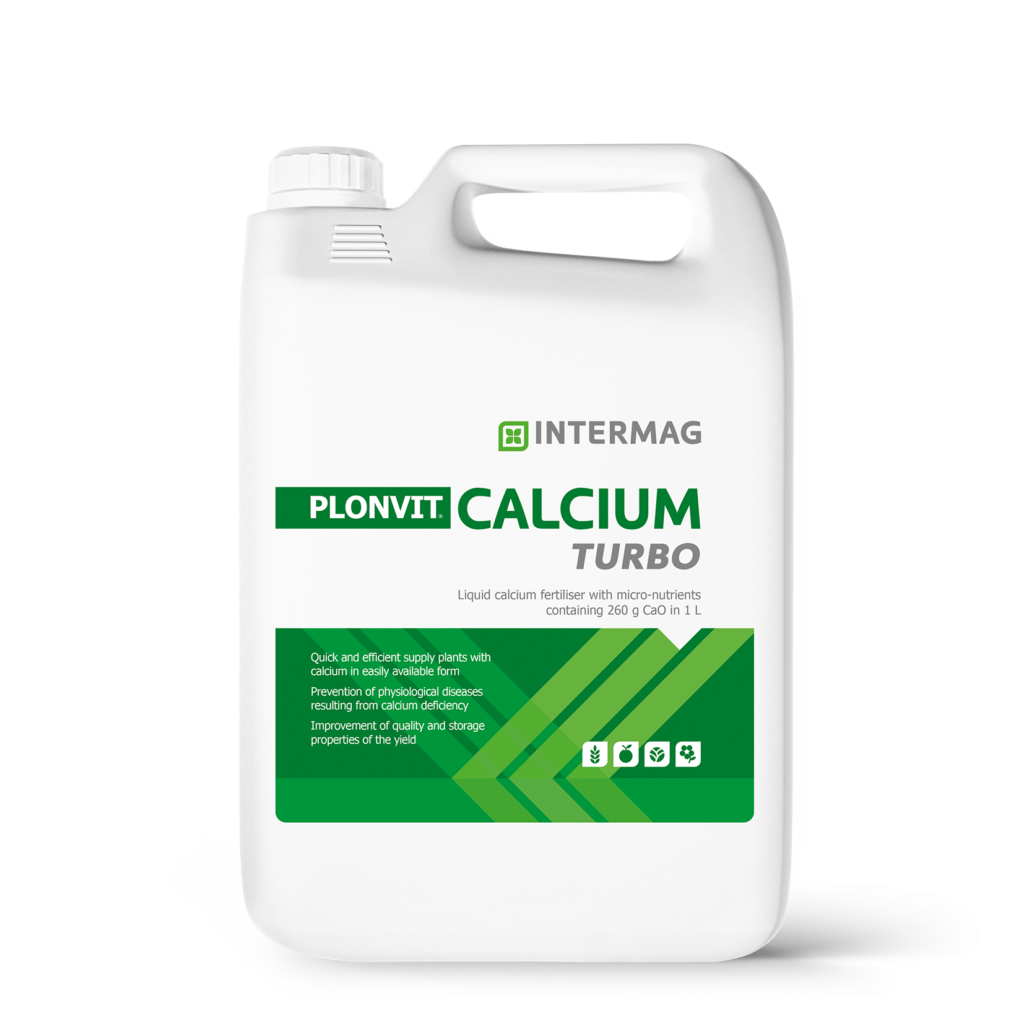
PLONVIT® CALCIUM TURBO
Fertilizante cálcico líquido con micronutrientes que contiene 260 g de CaO en 1 litro
Descripción del producto
PLONVIT® CALCIUM TURBO es un moderno fertilizante de calcio (260 g de CaO en 1 litro) enriquecido con magnesio y oligoelementos.
PLONVIT® CALCIUM TURBO El fertilizante utiliza la tecnología INT, lo que hace que la preparación sea extremadamente efectiva: la planta absorbe el calcio muy rápidamente y se traslada a todos los órganos, asegurando su correcto crecimiento y desarrollo.
Los ingredientes enriquecedores del fertilizante (magnesio (Mg), boro (B), cobre (Cu), molibdeno (Mo) y zinc (Zn) tienen además un efecto positivo en la cantidad y calidad del cultivo.
PLONVIT® CALCIUM TURBO se recomienda para la alimentación foliar, así como para su uso con riego (fertirrigación) de cultivos con mayor necesidad de calcio.
La alimentación foliar con calcio es necesaria, especialmente en cultivos hortícolas, debido al limitado movimiento y transporte de iones Ca2+ en las plantas.
Esta forma de suministrar calcio a las plantas previene la aparición de enfermedades fisiológicas como la pudrición seca de la punta en los tomates, la mancha hipodérmica amarga en las manzanas, la «quemadura de la punta» en las verduras brassica.
PLONVIT® CALCIUM TURBO es un componente indispensable de la tecnología de cultivos hortícolas para el mercado fresco y el procesamiento.
Cuando se utiliza en cultivos agrícolas, especialmente tubérculos, aumenta el contenido de sustancias de reserva, como el azúcar en la remolacha azucarera.
| Nutrientes | g/L | % (m/m) |
| Nitrógeno (N) total | 128 | 8.5 |
| Nitrato de nitrógeno (N) (NO3) | 120 | 8.0 |
| Óxido de calcio (CaO) | 260 | 17.0 |
| Óxido de magnesio (MgO) soluble en agua | 10 | 0.7 |
| Boron (B) in the form of acid | 0.75 | 0.05 |
| Copper (Cu) in the form of chloride | 0.3 | 0.02 |
| Molybdenum (Mo) in the form of ammonium salt | 0.015 | 0.001 |
| Zinc (Zn) in the form of nitrate | 0.3 | 0.020 |
| Nutrientes | g/L | % (m/m) |
| Nitrógeno (N) total | 128 | 8.5 |
| Nitrato de nitrógeno (N) (NO3) | 120 | 8.0 |
| Óxido de calcio (CaO) | 260 | 17.0 |
| Óxido de magnesio (MgO) soluble en agua | 10 | 0.7 |
| Boro (B) en forma de ácido | 0.75 | 0.05 |
| Cobre (Cu) en forma de cloruro | 0.3 | 0.02 |
| Molibdeno (Mo) en forma de sal de amonio | 0.015 | 0.001 |
| Zinc (Zn) en forma de nitrato | 0.3 | 0.020 |
PLONVIT®CALCIUM TURBO Se recomienda usar de forma profiláctica (preventiva), antes de la aparición de síntomas visuales de deficiencia de calcio en las plantas. Permitir los síntomas de deficiencia siempre conduce a una reducción en la cantidad y calidad del cultivo. Particularmente importantes son los tratamientos realizados durante períodos de crecimiento intensivo y la formación y crecimiento de frutos, tubérculos o raíces de almacenamiento.
Las plantas con requerimientos de calcio particularmente altos incluyen manzanas, peras, árboles de piedra, fresas, tomates, pimientos, plantas de brassica, tubérculos y bayas, entre otros.
PLONVIT® CALCIUM TURBO Utilizado en los tiempos y dosis recomendados en los programas de fertilización de especies individuales, complementa y/o corrige eficazmente la fertilización del suelo y proporciona calcio disponible para las plantas durante los períodos de mayor demanda de este componente por parte de las plantas.
Se recomienda la alimentación de intervención cuando hay síntomas visuales de deficiencia de calcio en las plantas o cuando los resultados del análisis del material vegetal indican un contenido de calcio demasiado bajo (deficiencia latente). Las aplicaciones de intervención deben realizarse solo en los casos en que los tratamientos preventivos no puedan llevarse a cabo de manera oportuna. Incluso una aparición a corto plazo de deficiencia de calcio puede reducir significativamente la cantidad y calidad del cultivo.
Calcio suministrado en PLONVIT® CALCIUM TURBO El fertilizante tiene un efecto positivo en la cantidad y calidad del rendimiento al:
- Reducir la aparición de enfermedades fisiológicas de frutas y verduras
- fortalecer y estabilizar la estructura de las paredes celulares (mejora la tolerancia de las plantas a condiciones ambientales desfavorables y daños mecánicos durante el transporte)
- desarrollo y crecimiento adecuados de los órganos individuales de las plantas, incluidos los órganos generativos (flores, primordios)
- Aumento de la resistencia de las plantas a las enfermedades fúngicas
- mejorar la eficiencia de la polinización y el cuajado
- Aumentar la firmeza de las frutas y verduras
- estimular la maduración uniforme de frutas y verduras
- mejorar la capacidad de almacenamiento del cultivo y extender el período de almacenamiento
PLONVIT® CALCIUM TURBO tiene un efecto muy positivo en el rendimiento y su calidad, incluido el consumo y el almacenamiento.
Instrucciones de uso
- RADIADORES FOLIARES PLONVIT® CALCIUM TURBO está destinado a la aplicación foliar en forma de solución acuosa. PLONVIT® CALCIUM TURBO Se puede utilizar junto con otros agroquímicos después de realizar una prueba de miscibilidad.
Las recomendaciones detalladas para la aplicación foliar se presentan en la siguiente tabla. Recomendaciones de aplicación foliar para cultivos seleccionados.
Las recomendaciones pueden modificarse teniendo en cuenta los requisitos y las condiciones de crecimiento de las plantas.
| Application times (◆ optimal, ◇ optional): | Direction for use: |
| ◇ Autumn: 3–6 leaves unfolded | 4–6 L/ha |
| ◇ Spring: tillering | 4–6 L/ha |
| ◇ stem elongation | 4–6 L/ha |
| ◇/◆ heading – until early milk (except of flowering period, when foliar treatments are not recommended) The treatment should be considered as optimal to improve the quality parameters of the grain (falling number) when high quality varieties are grown and in case of poor calcium uptake conditions (e.g. poor calcium content in the soil, water shortage). |
4–6 L/ha |
| Application times (◆ optimal, ◇ optional): | Direction for use: |
| ◇ leaf development – tillering | 4–6 L/ha |
| ◇ stem elongation | 4–6 L/ha |
| ◇/◆ heading – until early milk (except of flowering period, when foliar treatments are not recommended) The treatment should be considered as optimal to improve the quality parameters of the grain (falling number) when high quality varieties are grown and in case of poor calcium uptake conditions (e.g. poor calcium content in the soil, water shortage). |
4–6 L/ha |
| Application times (◆ optimal, ◇ optional): | Direction for use: |
| ◇ Autumn: 3–6 leaves unfolded | 4–6 L/ha |
| ◇ Spring: continuation of tillering | 4–6 L/ha |
| ◇ stem elongation | 4–6 L/ha |
| ◇ flag leaf stage / beginning of heading | 4–6 L/ha |
| Application times (◆ optimal, ◇ optional): | Direction for use: |
| ◇ leaf development – tillering | 4–6 L/ha |
| ◇ stem elongation | 4–6 L/ha |
| ◇ flag leaf stage / beginning of heading | 4–6 L/ha |
| Application times (◆ optimal, ◇ optional): | Direction for use: |
| ◇ Autumn: leaf development – until beginning of tillering | 4–6 L/ha |
| ◇ Spring: beginning of stem elongation | 4–6 L/ha |
| ◇ flag leaf stage – until first awns visible | 4–6 L/ha |
| Application times (◆ optimal, ◇ optional): | Direction for use: |
| ◇ leaf development – until beginning of stem elongation | 4–6 L/ha |
| ◇ flag leaf stage – until first awns visible | 4–6 L/ha |
| Application times (◆ optimal, ◇ optional): | Direction for use: |
| ◇Autumn: leaf development – until beginning of tillering | 4–6 L/ha |
| ◇ Spring: beginning of stem elongation | 4–6 L/ha |
| ◇ flag leaf stage – until first awns visible | 4–6 L/ha |
| Application times (◆ optimal, ◇ optional): | Direction for use: |
| ◇ leaf development – until beginning of stem elongation | 4–6 L/ha |
| ◇ flag leaf stage – until first awns visible | 4–6 L/ha |
| Application times (◆ optimal, ◇ optional): | Direction for use: |
| ◇ Autumn: leaf development – until beginning of tillering | 4–6 L/ha |
| ◇ Spring: beginning of steam elongation | 4–6 L/ha |
| ◇ flag leaf stage – until beginning of heading | 4–6 L/ha |
| Application times (◆ optimal, ◇ optional): | Direction for use: |
| ◇ leaf development – until beginning of stem elongation | 4–6 L/ha |
| ◇ flag leaf stage – until beginning of heading | 4–6 L/ha |
| Application times (◆ optimal, ◇ optional): | Direction for use: |
| ◇ leaf development – tillering | 4–6 L/ha |
| ◇ stem elongation – until flag leaf stage | 4–6 L/ha |
| Application times (◆ optimal, ◇ optional): | Direction for use: |
| ◇Spring: beginning of main stem elongation | 4–6 L/ha |
| ◇/◆ bud formation – until beginning of flowering The treatment should be considered as optimal in case of poor calcium uptake conditions (e.g. poor calcium resources in the soil, water scarcity). |
4–6 L/ha |
| Application times (◆ optimal, ◇ optional): | Direction for use: |
| ◇ leaf development – until beginning of main stem elongation | 4–6 L/ha |
| ◇/◆ bud formation – until beginning of flowering The treatment should be considered as optimal in case of poor calcium uptake conditions (e.g. poor calcium resources in the soil, water scarcity). |
4–6 L/ha |
| Application times (◆ optimal, ◇ optional): | Direction for use: |
| ◇ 2–3 pairs of leaves (BBCH 14–16) | 4–6 L/ha |
| ◆ stem elongation until inflorescence emergence (BBCH 30–53) | 4–6 L/ha |
| Application times (◆ optimal, ◇ optional): | Direction for use: |
| ◇ 2 leaf pairs unfolded until flax reaches height of 18 cm (BBCH 12–19) | 4–6 L/ha |
| ◆ stem growth until bud formation (BBCH 30–55) | 4–6 L/ha |
| Application times (◆ optimal, ◇ optional): | Direction for use: |
| ◇ 2–6 leaves unfolded (4 leaves is the optimum stage for treatment) | 4–6 L/ha |
| ◇ 7–8 leaves unfolded | 4–6 L/ha |
| Application times (◆ optimal, ◇ optional): | Direction for use: |
| ◇/◆ beginning of leaf development The treatment should be considered as optimal in the case of limited calcium uptake from soil (eg low calcium content in soil, soil pH below 5.8, high concentration of phosphorus in soil, water shortage in soil). |
4–6 L/ha |
| ◇/◆ beginning of storage root development The treatment should be considered as optimal in the case of limited calcium uptake from soil (eg low calcium content in soil, soil pH below 5.8, high concentration of phosphorus in soil, deficiency of water in soil). |
4–6 L/ha |
| ◆ 14–21 days after beginning of storage root development | 4–6 L/ha |
| Application times (◆ optimal, ◇ optional): | Direction for use: |
| ◆ growth of shoots and leaves (plant height ˃15 cm) | 4–6 L/ha |
| ◆ beginning of tuber growth | 4–6 L/ha |
| ◇/◆ tuber growth The treatment should be considered as optimal in case of poor calcium uptake conditions (e.g. poor calcium content in the soil, water shortage). |
4–6 L/ha |
| Application times (◆ optimal, ◇ optional): | Direction for use: |
| ◇ beginning of growth of shoots | 2–3 L/ha |
| ◇ beginning of flower bud development | 2–3 L/ha |
| ◆ beginning of pod and seed development: 1–2 treatments every 7–14 days | 2–3 L/ha |
| Application times (◆ optimal, ◇ optional): | Direction for use: |
| ◇ beginning of growth of shoots | 2–3 L/ha |
| ◇ beginning of flower bud development | 2–3 L/ha |
| ◆ beginning of pod and seed development: 1–2 treatments every 7–14 days | 2–3 L/ha |
| Application times (◆ optimal, ◇ optional): | Direction for use: |
| ◇ beginning of growth of shoots | 2–3 L/ha |
| ◇ beginning of flower bud development | 2–3 L/ha |
| ◆ beginning of pod and seed development: 1–2 treatments every 7–14 days | 2–3 L/ha |
| Application times (◆ optimal, ◇ optional): | Direction for use: |
| ◇ beginning of growth of shoots | 2–3 L/ha |
| ◇ beginning of flower bud development | 2–3 L/ha |
| ◆ beginning of pod and seed development: 1–2 treatments every 7–14 days | 2–3 L/ha |
| Application times (◆ optimal, ◇ optional): | Direction for use: |
| ◇ beginning of growth of shoots | 2–3 L/ha |
| ◇ beginning of flower bud development | 2–3 L/ha |
| ◆ beginning of pod and seed development: 1–2 treatments every 7–14 days | 2–3 L/ha |
| Application times (◆ optimal, ◇ optional): | Direction for use: |
| ◇ beginning of growth of shoots | 2–3 L/ha |
| ◇ beginning of flower bud development | 2–3 L/ha |
| ◆ beginning of pod and seed development: 1–2 treatments every 7–14 days | 2–3 L/ha |
| Application times (◆ optimal, ◇ optional): | Direction for use: |
| ◇ beginning of growth of shoots | 2–3 L/ha |
| ◇ beginning of flower bud development | 2–3 L/ha |
| ◆ beginning of pod and seed development: 1–2 treatments every 7–14 days | 2–3 L/ha |
| Application times (◆ optimal, ◇ optional): | Direction for use: |
| ◇ beginning of growth of shoots | 2–3 L/ha |
| ◇ beginning of flower bud development | 2–3 L/ha |
| ◆ beginning of pod and seed development: 1–2 treatments every 7–14 days | 2–3 L/ha |
| Application times (◆ optimal, ◇ optional): | Direction for use: |
| ◇ beginning of growth of shoots | 2–3 L/ha |
| ◇ beginning of flower bud development | 2–3 L/ha |
| ◆ beginning of pod and seed development: 1–2 treatments every 7–14 days | 2–3 L/ha |
| Application times (◆ optimal, ◇ optional): | Direction for use: |
| ◇ 4–6 leaves (BBCH 14–16) | 4–6 L/ha |
| ◆ leaf development until beginning of stem elongation (BBCH 19–31) | 4–6 L/ha |
| Application times (◆ optimal, ◇ optional): | Direction for use: |
| ◇ 4–6 leaves (BBCH 14–16) | 4–6 L/ha |
| ◆ stem elongation (BBCH 31–33) | 4–6 L/ha |
| ◇ stem elongation until beginning of tassel development (BBCH 35–51) | 4–6 L/ha |
| Application times (◆ optimal, ◇ optional): | Direction for use: |
| ◇ leaf development – tillering | 4–6 L/ha |
| ◆ beginning of stem formation | 4–6 L/ha |
| ◇ stem elongation | 4–6 L/ha |
| ◆ beginning of panicle emergence | 4–6 L/ha |
| Application times (◆ optimal, ◇ optional): | Direction for use: |
| ◇ beginning of side shoots formation | 4–6 L/ha |
| ◆ beginning of flower bud development | 4–6 L/ha |
| Application times for foliar treatments (◆ optimal, ◇ optional): | Direction for use: |
| ◇ end of flowering: majority of petals fallen | Foliar treatments – single dose 4-6 L/ha |
| ◇ beginning of fruit development | |
| ◆ growth of fruits: 3–5 treatments every 7–14 days | |
| ◆ beginning of fruit ripening: 1–2 treatments every 7–14 days |
| Application times for foliar treatments (◆ optimal, ◇ optional): | Direction for use: |
| ◇ beginning of fruit development | Foliar treatments – single dose 4-6 L/ha |
| ◆ growth of fruits: 2–3 treatments every 7–21 days | |
| ◆ beginning of fruit ripening: 1–2 treatments every 7–14 days |
| Application times for foliar treatments (◆ optimal, ◇ optional): | Direction for use: |
| ◇ end of flowering: majority of petals fallen | Foliar treatments – single dose 4-6 L/ha |
| ◆ growth of fruits: 3–5 treatments every 7–14 days | |
| ◆ beginning of fruit ripening |
| Application times for foliar treatments (◆ optimal, ◇ optional): | Direction for use: |
| ◇ beginning of fruit development | Foliar treatments – single dose 4-6 L/ha |
| ◆ growth of fruits: 3–5 treatments every 7–14 days | |
| ◆ beginning of fruit ripening |
| Application times for foliar treatments (◆ optimal, ◇ optional): | Direction for use: |
| ◇ fruitlet development | Foliar treatments – single dose 4-6 L/ha |
| ◆ fruit growth: 3 treatments every 5–7 days | |
| ◆ beginning of maturation | |
| ◇ Prevention of fruit cracking: each time directly before the expected rainfall or during rainfall (0.1–0.3% solution) |
| Application times for foliar treatments (◆ optimal, ◇ optional): | Direction for use: |
| ◆ fruit growth: 3 treatments every 5–7 days | Foliar treatments – single dose 4-6 L/ha |
| ◆ beginning of maturation | |
| ◇ Prevention of fruit cracking: each time directly before the expected rainfall or during rainfall (0.1–0.3% solution) |
| Application times for foliar treatments (◆ optimal, ◇ optional): | Direction for use: |
| ◇ fruitlet development | Foliar treatments – single dose 4-6 L/ha |
| ◆ fruit growth: 3 treatments every 5–7 days | |
| ◆ beginning of maturation | |
| ◇ Prevention of fruit cracking: each time directly before the expected rainfall or during rainfall (0.1–0.3% solution) |
| Application times for foliar treatments (◆ optimal, ◇ optional): | Direction for use: |
| ◆ fruit growth: 3 treatments every 5–7 days | Foliar treatments – single dose 4-6 L/ha |
| ◆ beginning of maturation | |
| ◇ Prevention of fruit cracking: each time directly before the expected rainfall or during rainfall (0.1–0.3% solution) |
| Application times for foliar treatments (◆ optimal, ◇ optional): | Direction for use: |
| ◇ fruitlet development | Foliar treatments – single dose 4–6 L/ha |
| ◆ fruit growth: 4–5 treatments every 7–10 days | |
| ◆ beginning of maturation |
| Application times for foliar treatments (◆ optimal, ◇ optional): | Direction for use: |
| ◇ fruitlet development | Foliar treatments – single dose 4–6 L/ha |
| ◆ fruit growth: 4–5 treatments every 7–10 days | |
| ◆ beginning of maturation |
| Application times for foliar treatments (◆ optimal, ◇ optional): | Direction for use: |
| ◇ fruitlet development | Foliar treatments – single dose 4–6 L/ha |
| ◆ fruit growth: 4–5 treatments every 7–10 days | |
| ◆ beginning of maturation |
| Application times for foliar treatments (◆ optimal, ◇ optional): | Direction for use: |
| ◇ fruitlet development | Foliar treatments – single dose 4–6 L/ha |
| ◆ fruit growth: 4–5 treatments every 7–10 days | |
| ◆ beginning of maturation |
| Application times (◆ optimal, ◇ optional): | Direction for use: |
| ◆ beginning of fruit development | 4–6 L/ha |
| ◆ intensive fruit growth: 2 treatments every 10–14 days | 4–6 L/ha |
| ◆ beginning of fruit colouring | 4–6 L/ha |
| Application times (◆ optimal, ◇ optional): | Direction for use: |
| ◇ fruit set | 4–6 L/ha |
| ◆ beginning of fruit development | 4–6 L/ha |
| ◆ beginning of core hardening | 4–6 L/ha |
| ◆ fruit flesh development (beginning of oil production) | 4–6 L/ha |
| ◇/◆ beginning of fruit coloration – picking of green olives The treatment should be considered as optimal for growing plants to the harvest maturity. |
4–6 L/ha |
| ◇/◆ beginning of maturation The treatment should be considered as optimal in case of growing table olives. |
4–6 L/ha |
| Application times (◆ optimal, ◇ optional): | Direction for use: |
| ◆ pinhead: 2 treatments every 14–21 days | 4–6 L/ha |
| ◆ intensive growth of fruit: 3 treatments every 10–14 days | 4–6 L/ha |
| ◆ maturation | 4–6 L/ha |
| Application times (◆ optimal, ◇ optional): | Direction for use: |
| ◇ petals falling until end of flowering (BBCH 67–69) | 4–6 L/ha |
| ◆ 2 treatments during fruit development (BBCH 71–75) | 4–6 L/ha |
| ◆ beginning of fruit ripening (colouring) (BBCH 81) | 4–6 L/ha |
| Application times (◆ optimal, ◇ optional): | Direction for use: |
| ◇ petals falling until end of flowering (BBCH 67–69) | 4–6 L/ha |
| ◆ 3 treatments during fruit development (BBCH 72–77) | 4–6 L/ha |
| Application times (◆ optimal, ◇ optional): | Direction for use: |
| ◆ 3 treatments during fruit development (BBCH 71–77) | 4–6 L/ha |
| ◇ beginning of fruit ripening (colouring) (BBCH 81) | 4–6 L/ha |
| Application times for foliar treatments (◆ optimal, ◇ optional): | Direction for use: |
| ◆ growth of fruits – until beginning of ripening: 1–3 treatments every 7–14 days | Foliar treatments – single dose 4–6 L/ha |
| Application times for foliar treatments (◆ optimal, ◇ optional): | Direction for use: |
| ◇ beginning of the first inflorescence emergence | Foliar treatments single dose 4–6 L/ha |
| ◆ beginning of the first fruit development | |
| ◆ growth and ripening of fruits: 3–4 treatments between successive harvests every 5–14 days |
| Application times for foliar treatments (◆ optimal, ◇ optional): | Direction for use: |
| ◇ beginning of inflorescence emergence | Foliar treatments single dose 4–6 L/ha |
| ◆ beginning of fruit development | |
| ◆ growth and ripening of fruits: 3–4 treatments between harvests every 5–7 days |
| Application times for foliar treatments (◆ optimal, ◇ optional): | Direction for use: |
| ◆ beginning of inflorence emergence | Foliar treatments single dose 4–6 L/ha |
| ◆ beginning of fruit development | |
| ◇ growth of fruits | |
| ◇ beginning of fruit ripening |
| Application times for foliar treatments (◆ optimal, ◇ optional): | Direction for use: |
| ◆ end of flowering / beginning of fruit development | Foliar treatments – single dose 4–6 L/ha |
| ◆ fruit development and maturation: 2–3 treatments every 10–14 days |
| Application times (◆ optimal, ◇ optional): | Direction for use: |
| ◆ fruit development – until berries pea-sized | 4–6 L/ha |
| ◆ berries beginning to touch | 4–6 L/ha |
| ◆ beginning of ripening | 4–6 L/ha |
| ◇ fruit coloring | 4–6 L/ha |
| Application times (◆ optimal, ◇ optional): | Direction for use: |
| ◆ Spring: leaf and crown development | 4–6 L/ha |
| ◆ Summer: further vegetative development and bud initiation for next season | 4–6 L/ha |
| Application times (◆ optimal, ◇ optional): | Direction for use: |
| ◇ balloon stage (forming of „hollow ball”) | 4–6 L/ha |
| ◆ beginning of the first fruit development | 4–6 L/ha |
| ◆ beginning of the first fruit ripening | 4–6 L/ha |
| ◆ immediately after first harvest | 4–6 L/ha |
| ◇ during fruit harvest, 1–2 treatments every 3–5 days | 4–6 L/ha |
| Application times (◆ optimal, ◇ optional): | Direction for use: |
| ◇ beginning of the first fruit development | 4–6 L/ha |
| ◆ fruit development and maturation: 2–3 treatments every 5–10 days | 4–6 L/ha |
| Application times (◆ optimal, ◇ optional): | Direction for use: |
| ◇ beginning of the first fruit development | 4–6 L/ha |
| ◆ fruit development and maturation: 2–3 treatments every 5–10 days | 4–6 L/ha |
| Application times (◆ optimal, ◇ optional): | Direction for use: |
| ◇ beginning of the first fruit development | 4–6 L/ha |
| ◆ development and ripening of the first fruit: 2 treatments every 5–7 days | 4–6 L/ha |
| ◆ fruiting period: 3–5 treatments every 14–28 days | 4–6 L/ha |
| Application times (◆ optimal, ◇ optional): | Direction for use: |
| ◆ Summer: development, growth and plantlet rooting | 4–6 L/ha |
| Application times for foliar treatments (◆ optimal, ◇ optional): | Direction for use: |
| ◇ after seedling adaptation to the field conditions – intensive plant growth | Foliar treatments – single dose 4–6 L/ha |
| ◆ beginning of inflorescence emergence | |
| ◆ beginning of flowering | |
| ◆ fruit development: 2–3 treatments every 7–14 days | |
| ◆ full yielding: 1–2 treatments every 7–14 days |
| Application times for foliar treatments (◆ optimal, ◇ optional): | Direction for use: |
| ◆ the inflorescence emergence – beginning of flowering: 1–2 treatments every 7–14 days | Foliar treatments – single dose 4–6 L/ha |
| ◆ fruit development: 1–3 treatments every 7–14 days | |
| ◆ full yielding: 1–2 treatments every 7–14 days |
| Application times for foliar treatments (◆ optimal, ◇ optional): | Direction for use: |
| ◇ the first inflorescence emergence – beginning of flowering: 1–2 treatments every 7–14 days | Foliar treatments – single dose 4–6 L/ha |
| ◆ beginning of fruit development: 1–3 treatments every 7–14 days | |
| ◆ after the following harvest: 1–2 treatments every 7–14 days |
| Application times for foliar treatments (◆ optimal, ◇ optional): | Direction for use: |
| ◇ after seedling adaptation to the field conditions – intensive plant growth | Foliar treatments – single dose 4–6 L/ha |
| ◆ the first flower bud emergence | |
| ◆ beginning of flowering | |
| ◆ fruit development: 2–3 treatments every 7–14 days | |
| ◆ full yielding: 1–2 treatments every 7–14 days |
| Application times for foliar treatments (◆ optimal, ◇ optional): | Direction for use: |
| ◇ after seedling adaptation to the field conditions – intensive plant growth | Foliar treatments – single dose 4–6 L/ha |
| ◇ the first flower bud emergence | |
| ◇ beginning of flowering | |
| ◆ fruit development: 1-2 treatments every 7–14 days | |
| ◆ full yielding: 1–2 treatments every 7–14 days |
| Application times (◆ optimal, ◇ optional): | Direction for use: |
| ◆ leaf development: 1–2 treatments every 7–14 days | Watering – 0.05–0.1% solution or spraying – 0.25–0.3% solution. |
| Application times for foliar treatments (◆ optimal, ◇ optional): | Direction for use: |
| ◆ 3–6 leaves unfolded | Foliar treatments – single dose 4–6 L/ha |
| ◆ intensive plant growth | |
| ◆ beginning of flowering | |
| ◆ after the first harvest | |
| ◆ after the following harvest: 1–3 treatments every 7–14 days |
| Application times for foliar treatments (◆ optimal, ◇ optional): | Direction for use: |
| ◇ 3–6 leaves unfolded | Foliar treatments – single dose 4–6 L/ha |
| ◇ intensive plant growth | |
| ◇ beginning of flowering | |
| ◇ after the first harvest | |
| ◇ after the following harvest: 1–3 treatments every 7–14 days |
| Application times for foliar treatments (◆ optimal, ◇ optional): | Direction for use: |
| ◆ 3–6 leaves unfolded | Foliar treatments – single dose 4–6 L/ha |
| ◆ intensive plant growth | |
| ◆ beginning of flowering | |
| ◆ after the first harvest | |
| ◆ after the following harvest: 1–3 treatments every 14–21 days |
| Application times for foliar treatments (◆ optimal, ◇ optional): | Direction for use: |
| ◇ 3–6 leaves unfolded | Foliar treatments – single dose 4–6 L/ha |
| ◇ intensive plant growth | |
| ◇ beginning of flowering | |
| ◇ after the first harvest | |
| ◇ after the following harvest: 1–3 treatments every 14–121days |
| Application times for foliar treatments (◆ optimal, ◇ optional): | Direction for use: |
| ◆ 3–6 leaves unfolded | Foliar treatments – single dose 4–6 L/ha |
| ◆ intensive plant growth | |
| ◆ beginning of flowering | |
| ◆ after the first harvest | |
| ◆ after the following harvest: 1–3 treatments every 14–21 days |
| Application times for foliar treatments (◆ optimal, ◇ optional): | Direction for use: |
| ◇ 3–6 leaves unfolded | Foliar treatments – single dose 4–6 L/ha |
| ◇ intensive plant growth | |
| ◇ beginning of flowering | |
| ◇ after the first harvest | |
| ◇ after the following harvest: 1–3 treatments every 14–21 days |
| Application times for foliar treatments (◆ optimal, ◇ optional): | Direction for use: |
| ◆ 3–6 leaves unfolded | Foliar treatments – single dose 4–6 L/ha |
| ◇ intensive plant growth | |
| ◇ beginning of flowering | |
| ◆ beginning of fruit development | |
| ◆ growth of fruits: 1–2 treatments every 14–21 days |
| Application times for foliar treatments (◆ optimal, ◇ optional): | Direction for use: |
| ◇ 3–6 leaves unfolded | Foliar treatments – single dose 4–6 L/ha |
| ◇ intensive plant growth | |
| ◇ beginning of flowering | |
| ◇ beginning of fruit development | |
| ◇ growth of fruits: 1–2 treatments every 14–21 days |
| Application times for foliar treatments (◆ optimal, ◇ optional): | Direction for use: |
| ◆ 3–6 leaves unfolded | Foliar treatments – single dose 4–6 L/ha |
| ◇ intensive plant growth | |
| ◇ beginning of flowering | |
| ◆ beginning of fruit development | |
| ◆ growth of fruits: 1–2 treatments every 14–21 days |
| Application times for foliar treatments (◆ optimal, ◇ optional): | Direction for use: |
| ◇ 3–6 leaves unfolded | Foliar treatments – single dose 4–6 L/ha |
| ◇ intensive plant growth | |
| ◇ beginning of flowering | |
| ◇ beginning of fruit development | |
| ◇ growth of fruits: 1–2 treatments every 14–21 days |
| Application times for foliar treatments (◆ optimal, ◇ optional): | Direction for use: |
| ◆ 3–6 leaves unfolded | Foliar treatments – single dose 4–6 L/ha |
| ◇ intensive plant growth | |
| ◇ beginning of flowering | |
| ◆ beginning of fruit development | |
| ◆ growth of fruits: 1–2 treatments every 14–21 days |
| Application times for foliar treatments (◆ optimal, ◇ optional): | Direction for use: |
| ◇ 3–6 leaves unfolded | Foliar treatments – single dose 4–6 L/ha |
| ◇ intensive plant growth | |
| ◇ beginning of flowering | |
| ◇ beginning of fruit development | |
| ◇ growth of fruits: 1–2 treatments every 14–21 days |
| Application times (◆ optimal, ◇ optional): | Direction for use: |
| ◆ growth of leaves | Watering – 0.05–0.1% solution or spraying – 0.25–0.3% solution |
| Application times for foliar treatments (◆ optimal, ◇ optional): | Direction for use: |
| ◇ growth of leaves | Foliar treatments – single dose 4–6 L/ha |
| ◇/◆ beginning of onion bulb formation The application time should be considered as optimal in the case of: poor or medium calcium content in the soil, high temperature, flooding of the roots. | |
| ◇/◆ bulb of onion reaches 30–50% of the expected size The application time should be considered as optimal in the case of: poor or medium calcium content in the soil, high temperature, flooding of the roots. |
| Application times for foliar treatments (◆ optimal, ◇ optional): | Direction for use: |
| ◇ growth of leaves | Foliar treatments – single dose 4–6 L/ha |
| ◇/◆ beginning of onion bulb formation The application time should be considered as optimal in the case of: poor or medium calcium content in the soil, high temperature, flooding of the roots. | |
| ◇/◆ bulb of onion reaches 30–50% of the expected size The application time should be considered as optimal in the case of: poor or medium calcium content in the soil, high temperature, flooding of the roots. |
| Application times for foliar treatments (◆ optimal, ◇ optional): | Direction for use: |
| ◇ growth of leaves | Foliar treatments – single dose 4–6 L/ha |
| ◇/◆ beginning of onion bulb formation The application time should be considered as optimal in the case of: poor or medium calcium content in the soil, high temperature, flooding of the roots. | |
| ◇/◆ bulb of onion reaches 30–50% of the expected size The application time should be considered as optimal in the case of: poor or medium calcium content in the soil, high temperature, flooding of the roots. |
| Application times for foliar treatments (◆ optimal, ◇ optional): | Direction for use: |
| ◇ growth of leaves | Foliar treatments – single dose 4–6 L/ha |
| ◇ growth of leaves – until beginning of onion bulb formation | |
| ◇ growth of onion bulb – until beginning of leaf bending over |
| Application times for foliar treatments (◆ optimal, ◇ optional): | Direction for use: |
| ◇ growth of leaves | Foliar treatments – single dose 4–6 L/ha |
| ◇/◆ beginning of garlic bulb formation The application time should be considered as optimal in the case of: poor or medium calcium content in the soil, high temperature, flooding of the roots. | |
| ◇/◆ bulb of garlic reach 30–50% of the expected size The application time should be considered as optimal in the case of: poor or medium calcium content in the soil, high temperature, flooding of the roots. |
| Application times for foliar treatments (◆ optimal, ◇ optional): | Direction for use: |
| ◇/◆ beginning of growth of plants The application time should be considered as optimal in the case of: poor or medium calcium content in the soil, high temperature, flooding of the roots. | Foliar treatments – single dose 4–6 L/ha |
| ◇/◆ harvestable plant part reach 30–50% of the typical size The application time should be considered as optimal in the case of: poor or medium calcium content in the soil, high temperature, flooding of the roots. |
| Application times (◆ optimal, ◇ optional): | Direction for use: |
| ◇ growth of leaves | Watering – 0.05–0.1% solution or spraying – 0.25–0.3% solution |
| Application times for foliar treatments (◆ optimal, ◇ optional): | Direction for use: |
| ◇ after seedling adaptation to field conditions – leaf development | Foliar treatments – single dose 4–6 L/ha |
| ◆ growth of leaves | |
| ◆ beginning of the flower head development | |
| ◆ growth of the flower head: 1–2 treatments every 7–10 days |
| Application times for foliar treatments (◆ optimal, ◇ optional): | Direction for use: |
| ◇ after seedling adaptation to field conditions – leaf development | Foliar treatments – single dose 4–6 L/ha |
| ◆ growth of leaves | |
| ◆ beginning of the flower head development | |
| ◆ growth of the flower head: 1–2 treatments every 7–10 days |
| Application times (◆ optimal, ◇ optional): | Direction for use: |
| ◇ after seedling adaptation to field conditions – leaf development | 4–6 L/ha |
| ◆ growth of leaves | 4–6 L/ha |
| ◆ beginning of the head formation | 4–6 L/ha |
| ◆ head reaches approx. 50% of the typical size | 4–6 L/ha |
| ◆ head reaches ca. 70–80% of the typical size | 4–6 L/ha |
| Application times (◆ optimal, ◇ optional): | Direction for use: |
| ◇ after seedling adaptation to field conditions – leaf development | 4–6 L/ha |
| ◆ growth of leaves | 4–6 L/ha |
| ◆ beginning of the head formation | 4–6 L/ha |
| ◆ head reaches approx. 50% of the typical size | 4–6 L/ha |
| ◆ head reaches ca. 70–80% of the typical size | 4–6 L/ha |
| Application times (◆ optimal, ◇ optional): | Direction for use: |
| ◇ after seedling adaptation to field conditions – leaf development | 4–6 L/ha |
| ◆ growth of leaves | 4–6 L/ha |
| ◆ beginning of the head formation | 4–6 L/ha |
| ◆ head reaches approx. 50% of the typical size | 4–6 L/ha |
| ◆ head reaches ca. 70–80% of the typical size | 4–6 L/ha |
| Application times (◆ optimal, ◇ optional): | Direction for use: |
| ◇ after seedling adaptation to field conditions – leaf development | 4–6 L/ha |
| ◆ growth of leaves | 4–6 L/ha |
| ◆ beginning of the head formation | 4–6 L/ha |
| ◆ head reaches approx. 50% of the typical size | 4–6 L/ha |
| ◆ head reaches ca. 70–80% of the typical size: 2 treatments every 7–14 days | 4–6 L/ha |
| Application times (◆ optimal, ◇ optional): | Direction for use: |
| ◇ after seedling adaptation to field conditions – leaf development | 4–6 L/ha |
| ◆ growth of the main stem and leaves | 4–6 L/ha |
| ◆ beginning of axillary bud (‘sprouts’) formation | 4–6 L/ha |
| ◆ approx. 50% of ‘sprouts’ are formed | 4–6 L/ha |
| Application times (◆ optimal, ◇ optional): | Direction for use: |
| ◇ after seedling adaptation to field conditions – leaf development | 4–6 L/ha |
| ◆ growth of leaves | 4–6 L/ha |
| Application times (◆ optimal, ◇ optional): | Direction for use: |
| ◇ after plant emergence – leaf development | 4–6 L/ha |
| Application times (◆ optimal, ◇ optional): | Direction for use: |
| ◇ after seedling adaptation to field conditions – leaf development | 4–6 L/ha |
| ◆ growth of the main stem and leaves | 4–6 L/ha |
| ◆ approx. 50% of the leaf mass formed | 4–6 L/ha |
| Application times (◆ optimal, ◇ optional): | Direction for use: |
| ◆ growth of leaves | watering 0.05–0.1% solution spraying 0.25–0.3% solution |
| Application times (◆ optimal, ◇ optional): | Direction for use: |
| ◆ 4–5 true leaves / root begins to expand (BBCH 14–15/41) | 4–6 L/ha |
| ◆ root reaches 20% of typical diameter (BBCH 42) | 4–6 L/ha |
| ◇ root reaches 30–40% of typical diameter (BBCH 43–44) | 4–6 L/ha |
| ◆ root reaches 50–70% of typical diameter (BBCH 45–47) | 4–6 L/ha |
| Application times (◆ optimal, ◇ optional): | Direction for use: |
| ◆ 4–5 true leaves / root begins to expand (BBCH 14–15/41) | 4–6 L/ha |
| ◆ root reaches 20% of typical diameter (BBCH 42) | 4–6 L/ha |
| ◇ root reaches 30–40% of typical diameter (BBCH 43–44) | 4–6 L/ha |
| ◆ root reaches 50–70% of typical diameter (BBCH 45–47) | 4–6 L/ha |
| Application times (◆ optimal, ◇ optional): | Direction for use: |
| ◆ 4–5 true leaves / root begins to expand (BBCH 14–15/41) | 4–6 L/ha |
| ◆ root reaches 20% of typical diameter (BBCH 42) | 4–6 L/ha |
| ◇ root reaches 30–40% of typical diameter (BBCH 43–44) | 4–6 L/ha |
| ◆ root reaches 50–70% of typical diameter (BBCH 45–47) | 4–6 L/ha |
| Application times (◆ optimal, ◇ optional): | Direction for use: |
| Seedling
◆ 1–3 true leaves (BBCH 11–13) |
watering 0.05–0.1% solution spraying 0.25–0.3% solution |
| Field-grown ◆ 7–9 true leaves / root begins to expand (BBCH 17–19/41) |
4–6 L/ha |
| ◆ root reaches 20% of typical diameter (BBCH 42) | 4–6 L/ha |
| ◆ root reaches 30–40% of typical diameter (BBCH 43–44) | 4–6 L/ha |
| ◆ root reaches 50–70% of typical diameter (BBCH 45–47) | 4–6 L/ha |
| Application times (◆ optimal, ◇ optional): | Direction for use: |
| ◆ 5 true leaves / beginning of crop cover (BBCH 15/31) | 4–6 L/ha |
| ◆ storage root begins to develop, diameter above 2 cm (BBCH 41–43) | 4–6 L/ha |
| ◆ root reaches 40–70% of typical diameter (BBCH 44–47) | 4–6 L/ha |


